Most B2B SaaS teams still treat the demo as the moment buyers decide. The research says that moment already happened. Preference forms in private research, peer talk, and vendor websites long before a calendar invite lands.
That is good news if your public messaging matches how buyers actually evaluate. It is expensive news if your homepage still reads like a platform brochure while your best reps sell a specific trigger event every week.
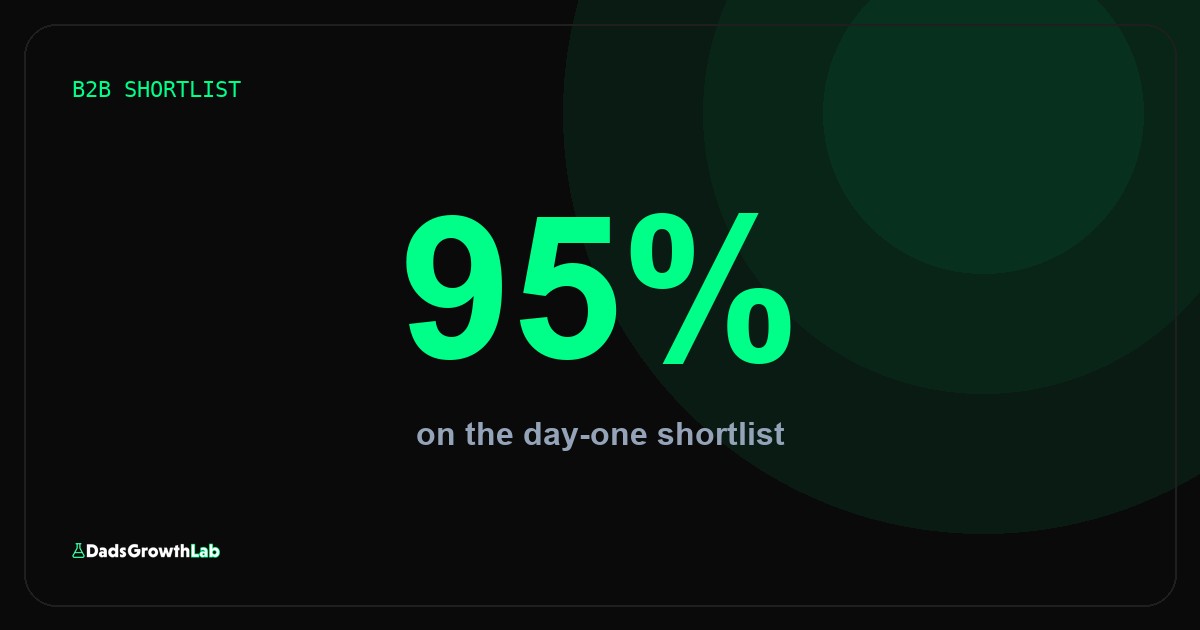
95%
of the time, the winning vendor was already on the day-one shortlist. About 4 out of 5 deals are still won by the pre-contact favorite.
Those numbers live next to related shortlist benchmarks in our B2B buyer journey statistics hub. The operator takeaway is blunt: late-stage demo polish cannot rescue a vendor that never made the early list.
What “pre-contact favorite” actually means for marketing
Buyers are not walking into demos neutral. They arrive with a ranked shortlist, a preferred vendor, and a set of objections already circulating inside the committee. Sales clarifies and de-risks. Marketing (and the website) either won or lost seat at that table weeks earlier.
6sense also reports that buying groups often rank vendors in preference order before initiating sales contact, and the vendor ranked first wins most of the time. That is why reactive inbound (you got the meeting late) converts worse than early shortlist presence. More of those journey numbers are unpacked in 6 B2B buyer journey stats for marketing teams.
Your demo is not the first impression. Your site already was.
On winning calls, reps talk about trigger events, proof, and the language buyers use with their boss. On many websites, the hero still sells categories: platform, insights, seamless workflows. That mismatch is why demos feel like rescue missions.
If you want a fast diagnosis, compare hero copy to a recent transcript with the Demo vs. Homepage Language Check. Five signs that gap is already live on your funnel: homepage and demo tell different stories.
What sales calls give you that keyword research cannot
Sales conversations reveal the exact objections, trigger events, and proof buyers needed before they booked. That is the raw material for being on the day-one shortlist:
- Trigger language: when the problem became urgent (not your ICP slide)
- Evaluation criteria: what the committee compares you on next week
- Internal objections: what champions have to sell upstairs without you in the room
- Proof that lands: metrics and story shapes that change preference
Tagging the difference between buying triggers and feature chatter is the job of marketing on call data. Start with buying triggers vs feature requests, then ship pages that answer those questions before outreach.
Ship shortlist content, not more “about us”
To win before the demo, publish assets that mimic a strong first sales conversation:
- Homepage and use-case pages that lead with buyer problems, not feature catalogs
- Comparison and alternative pages that match how committees actually rank vendors
- Objection-facing FAQs and proof pieces champions can forward
- A weekly cadence that updates language when call themes shift
That system is what a Marketing Brain Sprint builds over 90 days. If you only need the gap mapped first, the 7-Day Conversation Intelligence Audit analyzes 10-25 calls and shows where site copy diverges from the language that already wins deals. Proof of the build motion: B2B SaaS buyer intelligence case study.
What to do this week
- Score the gap on the Messaging Gap Scorecard.
- Run one homepage vs. demo language check on a closed-won transcript.
- List the top three objections from last month's calls. If they are missing from the website, you are late to the shortlist by design.
Full benchmark set: buyer journey statistics. Related alignment research: demo vs. homepage messaging stats. Operations pillar: scalable VoC content systems.
Related reading
- 5 signs your homepage and demo tell different stories
- 6 B2B buyer journey stats that explain why your homepage misses the committee
- Conversation intelligence for marketing teams
- Services overview and about Nathaniel Miller
Ready to map call language to shortlist pages? Tell me what you are working on.