Most B2B websites are written for a single economic buyer who reads the hero, books a demo, and brings one champion to the call. That is not how purchases happen. Committees research alone, rank vendors before outreach, and stall on internal consensus while your rep waits on a follow-up.
The stats below come from our B2B buyer journey statistics hub (44 sourced benchmarks). Pair it with alignment statistics and conversation intelligence statistics when you need messaging and call context. This post is the narrative version for marketing leaders sizing content investment before the shortlist hardens.
The committee is bigger than your persona slide
6–10
decision-makers in a typical complex B2B purchase. Forrester reports 13 people in the average enterprise buying group.
Source: Gartner B2B Buying Survey and Forrester B2B Buying Groups Research (2024)
Each member gathers 4 to 5 pieces of information independently before the group deliberates. Your homepage speaks to one role. Finance, security, ops, and end users scan different fears on different pages. One generic hero cannot carry ten stakeholders.
What to do this quarter: Map one objection and one buying trigger per persona from sales call transcripts, then assign one asset per role. Ship from calls, not from a workshop alone.
Buyers complete most of the journey without you
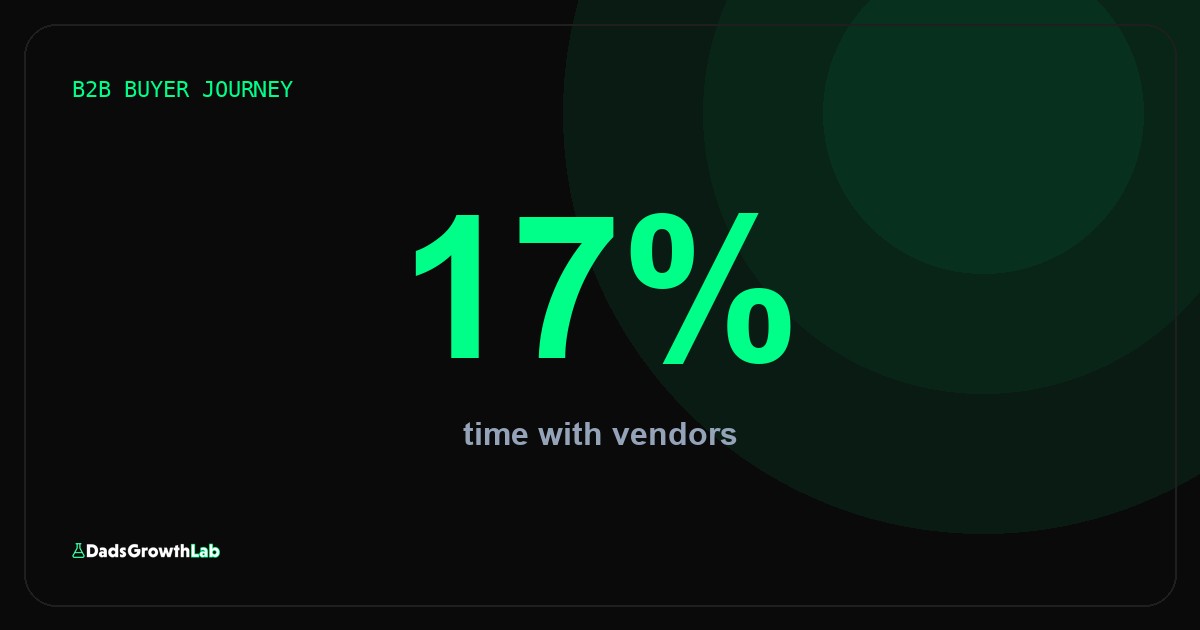
17%
of total B2B purchase time spent meeting with potential suppliers. Roughly 80% of the journey is self-directed.
Source: Gartner B2B Buying Survey (2024)
75%
of B2B buyers who prefer a rep-free buying experience when self-serve research is available.
Source: Gartner B2B Buying Survey (2024)
Marketing owns the 80% sellers never see. If your site only mirrors demo talk tracks, you under-invest in the research phase where shortlists form. See 6 B2B messaging stats on the demo vs. homepage gap for the copy side of the same problem.
What to do this week: Run the Demo vs. Homepage Language Check and compare hero copy to language buyers use on recorded calls.
Shortlists form before sales gets a meeting
92%
of B2B buyers who start their journey with at least one vendor already in mind. 81% choose a preferred vendor before first sales contact.
Source: Forrester B2B Buying Study (2024) and 6sense B2B Buyer Experience Report (2024)
6sense (2025) reports 94% of buying groups rank shortlists in preference order before initiating sales contact. The vendor ranked first wins about 80% of the time. Reactive inbound deals win at 18 to 25% versus 33 to 41% on proactive opportunities (Emblaze, 2025). Waiting for demos is a late-stage strategy.
What to do this month: Audit whether your top-of-funnel content answers the questions buyers use to rank vendors before outreach. Peer reviews, comparison pages, and ROI proof beat feature lists.
Most purchases stall. Most buyers regret the outcome.
86%
of B2B purchases that stall during the buying process. 81% of buyers report dissatisfaction with the provider they ultimately choose.
Source: Forrester B2B Buying Study (2024)
Stalls are not always a sales execution failure. They often reflect unclear problem definition across the committee, too many options, and messaging that does not help buyers build internal consensus. When sellers and buyers align on the problem definition early, win rates improve 38% (Emblaze, 2024).
What to do this month: Start an Objection Log in buyer words. Recurring internal blockers become forwardable assets for champions who sell when you are not in the room.
Buyers consume content and trust peers, not your homepage alone
13
content pieces consumed on average before first sales contact. 92% consult peer reviews before purchase.
Source: FocusVision (cited by Highspot, 2023) and G2 Buyer Behavior Report (2024)
Only 9% of buyers consider vendor websites reliable as a sole information source (G2, 2024). Meanwhile 65% of sales-enablement content goes unused by reps (Highspot, 2024). The gap is not volume. It is relevance to how committees decide.
Reference table: stats at a glance
| Stat | Claim | Source |
|---|---|---|
| 6–10 / 13 | Buying committee size | Gartner, Forrester (2024) |
| 17% / ~80% | Vendor contact vs. self-directed journey | Gartner (2024) |
| 75% | Rep-free buying preference | Gartner (2024) |
| 92% / 81% | Vendor in mind at start / chosen pre-contact | Forrester, 6sense (2024) |
| 86% / 81% | Stall rate / buyer dissatisfaction | Forrester (2024) |
| 13 / 92% | Content pre-contact / peer review usage | FocusVision, G2 |
From journey stats to committee-ready messaging
Committee-led buying rewards teams that ship language buyers can forward internally:
- Capture how each role describes the problem on calls and in tickets
- Map triggers and objections by persona, not one generic ICP
- Publish proof and comparison content for the self-directed 80%
- Compound by updating assets when call language shifts
That is the build motion behind our Marketing Brain Sprint. For a faster diagnostic on call vs. site language, start with the 7-Day Conversation Intelligence Audit. Proof in production: B2B SaaS buyer intelligence case study.
Related reading
- B2B buyer journey statistics hub (44 benchmarks)
- How B2B SaaS teams build scalable VoC content systems (pillar)
- 7 conversation intelligence stats for marketing
- Five signs your homepage and demo tell different stories
Where to start
Free: Messaging Gap Scorecard and alignment tools. When you have 10–25 transcripts, the audit maps committee language vs. your homepage in one week. Browse services, get in touch, or read about Nathaniel Miller.