Product sheets tell people what you sell. Thought leadership shows how you think about the buyer's problem. Only one of those reliably earns trust before a demo.
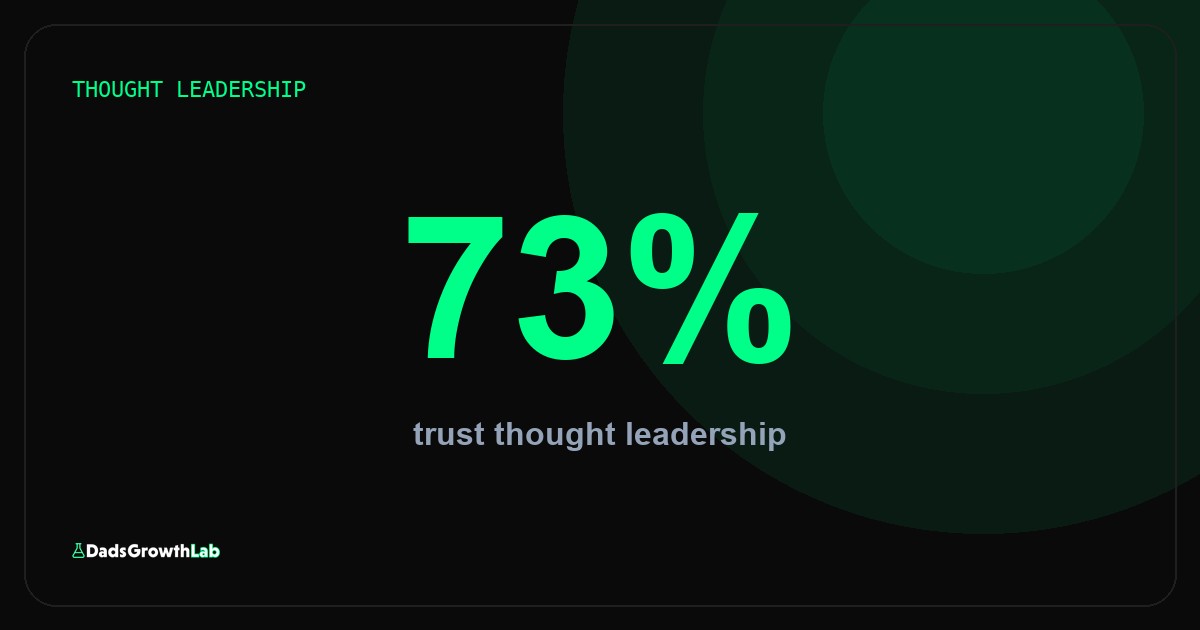
73%
of B2B decision-makers see thought leadership as a more trustworthy way to assess a company's capabilities than traditional marketing materials.
Source: LinkedIn / Edelman B2B Thought Leadership Impact Report (summarized in LinkedIn's B2B thought leadership examples, 2024)
That does not mean publish more vague “future of work” essays. It means teach the market something useful about the problems your best calls already diagnose. Related buyer-research and trust stats live in our B2B buyer journey statistics hub.
Why product sheets fail the trust test
A feature matrix assumes the buyer already believes you understand their world. Most do not. They are still comparing problem definitions across the committee, reading peers, and deciding which vendor “gets it.”
Product collateral answers what. POV content answers how we see the problem, what most teams get wrong, and what good looks like. That is closer to how sophisticated buyers evaluate capability under uncertainty. See also why the website has to win before the demo: preference forms before your PDF gets attached in an email.
Sales calls are the fastest POV research lab
Every repeating call theme is a draft thesis:
- “Teams come to us when the CRM forecast is fiction” → POV on forecast hygiene and data debt
- “Security review kills momentum for six weeks” → POV on buyer enablement for security questionnaires
- “They compare us to a spreadsheet, not a competitor” → POV on category education vs. feature wars
Extract buying triggers and objections first (buying triggers vs feature requests), then write the teaching piece around the pattern, not around your roadmap. That is also how you avoid the generic AI thought-leadership trap: the source is recorded buyer language, not a trend article.
What good B2B POV looks like in practice
- Name the buyer mistake you hear every week (without dunking on customers)
- Explain the cost in operator terms: stalled deals, bad shortlists, wasted enablement
- Give a usable frame: checklist, decision tree, language map, or diagnostic
- Prove it with call-shaped evidence: anonymized phrases, win/loss patterns, before/after messaging
- Connect lightly to how you help: service, system, or next step after the lesson lands
That stack is closer to a Marketing Brain Sprint deliverable than to a content calendar filled with product announcements. For how marketing should access call corpora without becoming sales ops: conversation intelligence for marketing teams.
POV still needs a shipping system
One brilliant essay does not compound. Teams that win on trust publish a cadence: capture → map themes → ship teaching assets → feed sales with forwardable links → refresh when call language shifts. That is the operations story in how B2B SaaS builds scalable VoC content systems.
If homepage and demo language already diverge, POV will not save you until the site matches the conversations. Diagnose that gap with the Demo vs. Homepage Language Check and the Messaging Gap Scorecard. Symptom checklist: five signs of homepage vs demo mismatch.
What to publish from last month's calls
- Pick the objection or trigger that showed up on at least five calls.
- Write one POV piece that teaches the market how to think about that problem.
- Turn the same theme into one sales-forwardable asset (one-pager, Loom, FAQ block).
- Update the related website section so product pages do not contradict the lesson.
Need a week to map themes from transcripts? Use the 7-Day Conversation Intelligence Audit. Want the full buyer-language content system in production: see the B2B SaaS buyer intelligence case study and browse services.