Most B2B SaaS teams treat sales enablement as a content library plus onboarding slides. The function exists. Adoption does not. The stats below connect unused assets, low selling time, and weak message pull-through to the same root cause: enablement built from internal messaging, not buyer language on live calls.
Full reference: B2B sales enablement statistics hub (42 sourced benchmarks). Implementation path: Sales Enablement. Pair with conversation intelligence statistics and voice of customer statistics when calls are your source of truth.
Most sales content never reaches a live conversation
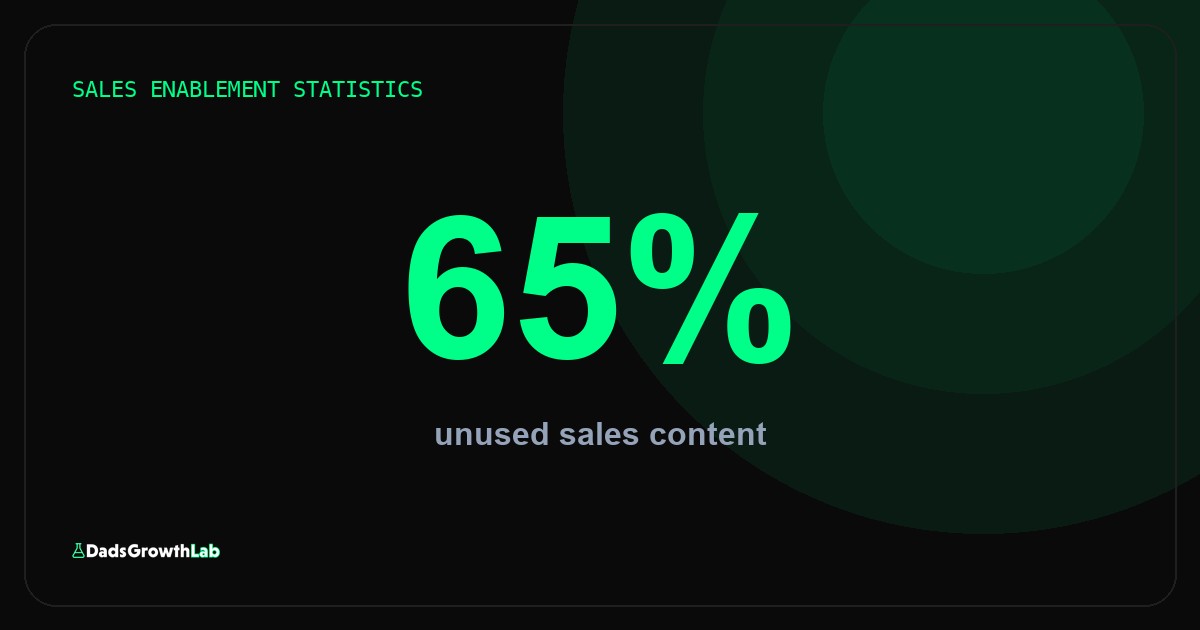
65%
of sales content created by marketing that goes unused, often because it is outdated or hard to find.
Source: Forrester Sales Content report (2018); reaffirmed in 2021 B2B content analysis
30%
of marketing-created content actually used by sales teams in industry enablement benchmarks.
Source: SiftHub compilation of enablement research
Forty percent of content gets recreated because reps cannot find what already exists. That is not a storage problem. It is a relevance problem. Assets written from positioning workshops do not match how buyers phrase risk on calls. The VoC content systems pillar routes call text into weekly ship slots so enablement updates from evidence, not guesses.
Reps do not have time to hunt for assets
30%
of rep time spent actively selling during an average week. 70% goes to non-selling tasks.
Source: Salesforce State of Sales, 6th Edition (2024, n=5,500)
When selling time is scarce, reps default to what worked on the last deal. Portal search loses to muscle memory every time. Gartner research cited in industry surveys finds 70% of sellers overwhelmed by required tools. Salesforce (2023) reports an average of 10 tools to close one deal. Enablement that adds another login without surfacing answers in workflow will stay unused.
Approved messaging rarely survives first contact
29%
of buyer-facing sales conversations reflecting documented core messaging when audited via call recordings.
Source: Pragmatic Institute Product Marketing Survey (2024)
Battlecards describe features marketing wants to emphasize. Calls surface objections buyers actually raise. Until those two corpora merge, enablement is decoration. A Conversation Intelligence Audit maps call patterns against positioning docs in one week. See also alignment statistics and 6 messaging alignment stats for the marketing side of the same gap.
Training investment only pays off when you measure ramp
36%
more likely to decrease seller ramp time when using analytics to measure training effectiveness.
Source: Highspot State of Sales Enablement (2024)
Onboarding decks without usage data are theater. Teams that tie readiness analytics to coaching see measurable ramp gains. Industry benchmarks cite 40 to 50% onboarding time reduction with formal programs, but only when content matches live deal motion. Run the Demo vs. Homepage Language Check before rebuilding another onboarding module.
Formal enablement moves win rates when it is operational
49%
higher win rate on forecasted deals for organizations with formal sales enablement strategies versus 43% without.
Source: Industry enablement research cited by Qwilr and G2
23%
more competitive deals won when battlecards are used effectively in live selling.
Source: SiftHub enablement benchmarks
Median B2B SaaS opportunity-to-close sits at 21% (Ebsta and Pavilion, cited by The Starr Conspiracy). Enablement should target late-stage execution, not more top-of-funnel PDFs. Proof of a working system: B2B SaaS buyer intelligence case study.
AI shifts enablement from libraries to in-deal guidance
3×
more effective at achieving sales goals for companies using AI in enablement workflows.
Source: Highspot State of Sales Enablement (2024)
Flowla's 2025 benchmark found 55% of enablement leaders want AI for deal coaching and insights, not auto-drafted emails. Salesforce (2024) reports 83% of AI-enabled sales teams saw revenue growth versus 66% without. The leverage is surfacing the right asset at the right moment, trained on calls that already happened.
Reference table
| Stat | Claim | Source |
|---|---|---|
| 65% | Sales content unused | Forrester |
| 30% | Rep time actively selling | Salesforce 2024 |
| 29% | Calls match core messaging | Pragmatic Institute |
| 36% | Ramp reduction with training analytics | Highspot 2024 |
| 49% | Win rate lift with formal enablement | Industry research |
| 3× | Sales goal effectiveness with AI | Highspot 2024 |
From content portal to call-backed playbooks
- Mine 10–25 recent calls for objections and trigger phrases
- Rewrite one battlecard section in buyer words per week
- Measure content usage and ramp, not upload volume
- Route new call text back into enablement monthly
That loop is what Sales Enablement and the Marketing Brain Sprint install together. Free diagnostic: Messaging Gap Scorecard.
Related reading
- B2B sales enablement statistics hub (42 benchmarks)
- 7 conversation intelligence stats
- 6 VoC stats that explain survey-only gaps
- VoC content systems pillar
Where to start
If battlecards feel polished but reps still wing competitive calls, start with call audits and one rewritten objection handler. Browse services, get in touch, or read about Nathaniel Miller.